Stop Writing Agent Pipelines From Scratch — Design Them Visually
Building multi-step AI agent workflows usually means writing a lot of boilerplate: chaining LLM calls, wiring outputs to inputs, handling retries and recovery, managing state. You spend more time on plumbing than on the actual logic.
I built Agentic Workflow Design Tool to fix this. You design agent workflows as visual graphs in a browser, then let a CLI agent (Claude Code, Codex, etc.) turn your sketch into a production-ready pipeline. No frameworks, no dependencies — just Python stdlib. GitHub: github.com/Shengrong-Wu/agentic-workflow-design-tool
How It Works
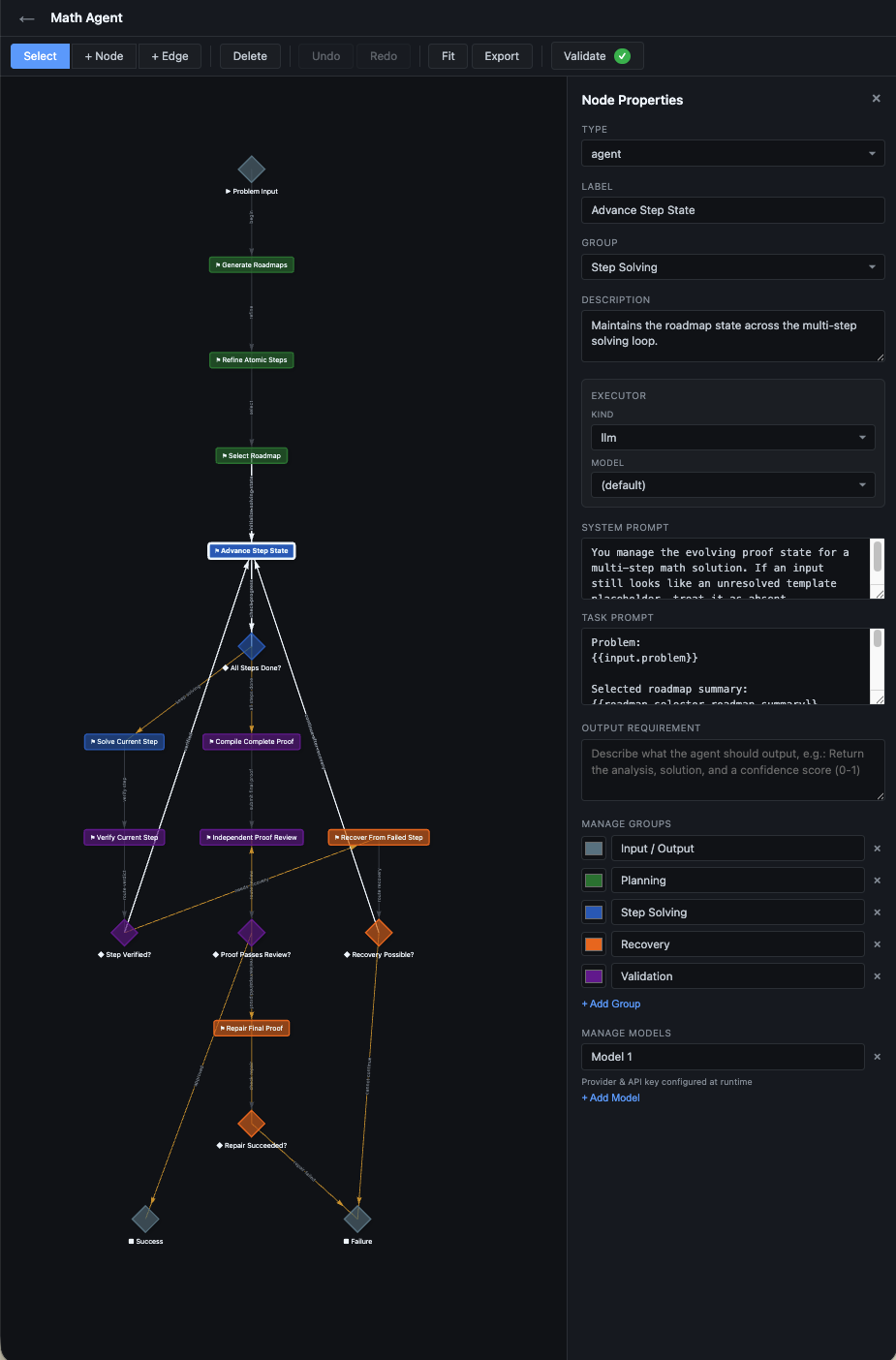
The workflow has two phases. In the design phase, you open a simplified web editor and draw your agent graph: nodes for each step, edges for the flow. You write system prompts, task prompts, and describe expected outputs in plain English — no JSON Schema required. The editor auto-saves your work as simplified-workflow.json.
In the improvement phase, you hand the file to a CLI agent. It reads your plain-text output descriptions and converts them to proper JSON Schema, infers input bindings from {variable} references in your prompts, configures tools and permissions, and adds guard expressions to decision edges. The result is a separate workflow.json that the runtime can execute directly. Your original design is never overwritten, so you can iterate freely.
You (human)                    CLI Agent                     Runtime
    │                              │                            │
    ├── Draw nodes & edges         │                            │
    ├── Write prompts              │                            │
    ├── Describe outputs           │                            │
    │   in plain text              │                            │
    │                              │                            │
    └── Save ─────────────────────>│                            │
         simplified-workflow.json  ├── Add output_schema        │
                                   ├── Add input bindings       │
                                   ├── Configure tools          │
                                   ├── Add guard expressions    │
                                   │                            │
                                   └── Save ───────────────────>│
                                        workflow.json           ├── Execute
                                                                ├── Produce results
                                                                └── Save artifacts
What the Runtime Does
The runtime is an event-sourced execution engine. It walks your graph, calls LLMs (Claude, GPT, Gemini, or DeepSeek), evaluates edge guards, handles tool calls, and checkpoints state after every node. If something fails, you can inspect, rewind, and resume. It also supports git worktree and Docker container isolation for safe execution.
A Real Example
The repo includes a math-agent — an 18-node proof pipeline translated from my Math-Research-Agent project, without the LEAN formal verification nodes. It generates multiple proof roadmaps, selects the best one, iterates through solve/verify cycles, and automatically recovers when a step fails verification.